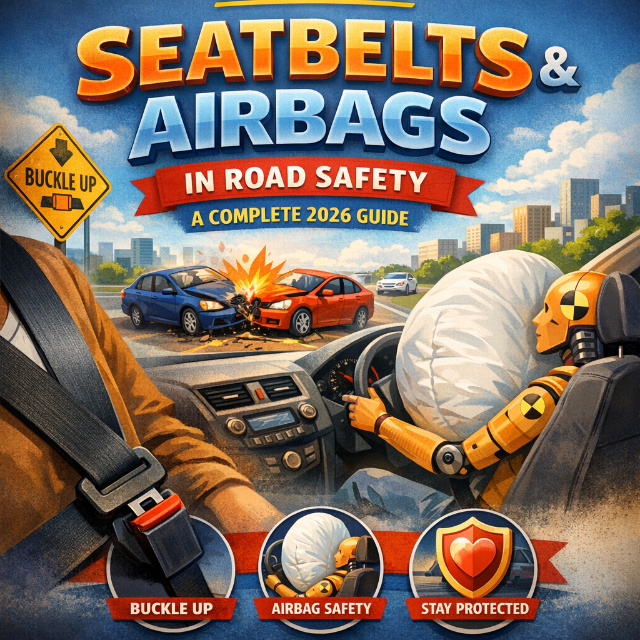
Introduction: The Foundation of Vehicle Safety
Every year, tens of thousands of lives are saved by two simple yet sophisticated safety devices: seatbelts and airbags. Despite being standard equipment in vehicles for decades, many drivers still don't fully understand how these systems work together or why proper usage is critical.
This comprehensive guide examines the science behind seatbelts and airbags, their life-saving effectiveness, proper usage techniques, and the latest innovations that continue to improve road safety in 2026.
Understanding the Statistics: Why These Systems Matter
The Sobering Reality
Seatbelt Effectiveness:
- Seatbelts reduce the risk of death by 45% for front-seat passengers
- They reduce the risk of serious injury by 50%
- Rear-seat seatbelts reduce fatal injuries by 25%
- Ejection from a vehicle is 75% fatal, and seatbelts prevent ejection in most cases
-
Airbag Impact:
- Frontal airbags reduce driver fatalities by 29%
- When combined with seatbelts, fatality reduction increases to 61%
- Side airbags with head protection reduce driver deaths by 37%
- Curtain airbags lower rear passenger deaths by 25%
-
The Unbuckled Truth:
- In 2024, 47% of vehicle occupants killed in crashes were not wearing seatbelts
- Nighttime crashes see even lower seatbelt usage rates
- States with primary seatbelt laws have 10% higher usage rates
These statistics underscore a critical truth: seatbelts and airbags are only effective when used correctly and in combination.
How Seatbelts Work: Your First Line of Defense
The Physics of Protection
When a vehicle suddenly stops in a crash, your body continues moving forward at the vehicle's original speed due to inertia. A seatbelt's job is to:
- Restrain your body to prevent ejection and impact with the interior
- Distribute crash forces across the strongest parts of your body (chest, pelvis, shoulders)
- Extend stopping time to reduce the force of deceleration
- Position you correctly for airbag deployment
The Three-Point Seatbelt System
Modern vehicles use the three-point seatbelt design, invented by Volvo engineer Nils Bohlin in 1959:
Lap Belt Component:
- Crosses the pelvis and hips
- Anchored to the vehicle frame
- Designed to engage the strong pelvic bones
- Prevents "submarining" (sliding under the belt)
-
Shoulder Belt Component:
- Crosses the chest and collarbone
- Distributes force across the rib cage
- Prevents the head and torso from striking the steering wheel or dashboard
- Keeps you in position for airbag protection
-
Retractor Mechanism:
- Allows free movement during normal driving
- Locks instantly during sudden deceleration
- Uses a pendulum or ball-in-tube mechanism
- Responds within milliseconds of impact
-
Advanced Seatbelt Technologies (2026)
Pretensioners:
- Automatically tighten the belt during a crash
- Remove slack before impact
- Position occupant optimally in seat
- Activated by crash sensors
-
Load Limiters:
- Allow controlled belt release during severe impacts
- Prevent chest injuries from excessive belt force
- Balance restraint with injury prevention
- Calibrated for different body types
-
Adjustable Upper Anchors:
- Allow positioning for different heights
- Ensure proper shoulder belt placement
- Critical for optimal protection
- Should rest on the collarbone, not the neck
-
Belt Reminders:
- Visual and audible warnings
- Detect occupancy and belt status
- Increasingly sophisticated systems
- Proven to increase buckle-up rates
-
How Airbags Work: The Secondary Safety System
Understanding Airbag Deployment
Airbags are supplemental restraint systems (SRS) designed to work with seatbelts, not replace them. Here's how they function:
Crash Detection (0-20 milliseconds):
- Electronic sensors detect sudden deceleration
- Accelerometers measure impact severity
- Computer analyzes crash type and direction
- Decision made to deploy specific airbags
-
Inflation (20-40 milliseconds):
- Chemical reaction produces nitrogen gas
- Bag inflates at speeds up to 200 mph
- Full inflation occurs in 30-50 milliseconds
- Faster than the blink of an eye
-
Deflation (40-150 milliseconds):
- Gas escapes through vent holes
- Allows controlled energy absorption
- Occupant "rides down" the crash
- Bag deflates to allow escape
-
Types of Airbags in Modern Vehicles
Frontal Airbags:
- Driver airbag: Located in the steering wheel center
- Passenger airbag: Located in dashboard
- Purpose: Protect head and chest in frontal impacts
- Coverage: Standard in all vehicles since 1998
-
Side-Impact Airbags:
- Torso bags: Deploy from seat or door
- Curtain bags: Deploy from roof rail
- Purpose: Protect head, chest, and pelvis in side crashes
- Coverage: Increasingly standard, highly effective
-
Knee Airbags:
- Deploy below dashboard
- Protect knees and legs
- Prevent submarining
- Reduce lower extremity injuries
-
Center Airbags:
- Deploy between front seats
- Prevent occupant-to-occupant contact
- Useful in side impacts and rollovers
- Featured in newer luxury vehicles
-
Rear Seat Airbags:
- Protect rear passengers
- Deploy from front seatbacks
- Increasing availability in 2026
- Especially important for children too large for car seats
-
Pedestrian Airbags:
- Deploy on hood exterior
- Protect pedestrians in frontal impacts
- Required in some markets
- Growing technology in 2026
-
Advanced Airbag Systems (2026)
Multi-Stage Deployment:
- Varies inflation force based on crash severity
- Considers occupant size and position
- Reduces injuries in minor crashes
- Optimizes protection in severe crashes
-
Occupant Detection:
- Sensors determine if seat is occupied
- Identifies occupant size and position
- Adjusts or suppresses airbag deployment
- Critical for child safety
-
Far-Side Airbags:
- Protect occupants from striking the opposite side interior
- Deploy between occupants during side impacts
- Prevent head and chest injuries
- Increasingly common in 2026 models
-
The Critical Partnership: Why Both Systems Are Essential
The Dangerous Misconception
Myth: "Airbags protect me, so I don't need a seatbelt."
Reality: Airbags are designed to work only with seatbelts. Without a seatbelt:
- You'll move too far forward: Striking the deploying airbag at high speed
- Impact forces increase: Airbag collision can cause serious injuries
- Positioning is wrong: Your body isn't where the airbag expects
- You can be ejected: Airbags don't prevent ejection; seatbelts do
How They Work Together
The Optimal Sequence:
Phase 1 - Pre-Impact (0-20ms):
- Pretensioners activate
- Seatbelt removes all slack
- Body positioned correctly in seat
-
Phase 2 - Initial Impact (20-50ms):
- Seatbelt begins restraining body
- Airbags deploy and inflate
- Forward motion starts to slow
-
Phase 3 - Maximum Deformation (50-100ms):
- Body presses against seatbelt
- Head and chest contact airbag
- Energy absorbed by both systems
- Load limiters may activate if needed
-
Phase 4 - Rebound (100-150ms):
- Airbag begins deflating
- Seatbelt continues restraint
- Body settles back into seat
- Crash forces dissipated
-
Result: Forces distributed, stopping distance extended, injuries minimized.
Proper Seatbelt Usage: Getting It Right Every Time
Correct Positioning
The Shoulder Belt Should:
- Rest across your collarbone and chest
- Never touch your neck or face
- Lay flat without twisting
- Be snug but comfortable
-
The Lap Belt Should:
- Sit low across your hips/pelvis
- Never across your stomach
- Be as snug as comfortable
- Touch your thighs
-
Adjustment Tips:
- Adjust the upper anchor point for your height
- Ensure the belt isn't trapped behind you
- Check that it moves freely from the retractor
- Adjust your seat position for proper fit
Common Mistakes to Avoid
Placing shoulder belt under arm or behind back
- Why it's dangerous: No upper body restraint, severe chest/abdominal injuries possible
- Why people do it: Discomfort, improper fit
- Solution: Adjust anchor height, correct seat position
-
Wearing lap belt too high on stomach
- Why it's dangerous: Can cause internal organ damage
- Why people do it: Unfamiliarity or discomfort
- Solution: Pull belt down to hips, ensure proper positioning
-
Leaving slack in the belt
- Why it's dangerous: Increases forward motion before restraint engages
- Why people do it: Desire for comfort
- Solution: Pull snug after buckling
-
Using belt clips or positioning devices
- Why it's dangerous: Defeats safety design, increases injury risk
- Why people do it: Discomfort concerns
- Solution: Address fit issues properly, adjust seat and belt
-
Sharing a seatbelt
- Why it's dangerous: Neither occupant is properly protected
- Why people do it: Insufficient belts or poor judgment
- Solution: Never share; one person per belt
-
Not wearing a seatbelt on short trips
- Why it's dangerous: Most crashes occur within 25 miles of home
- Why people do it: False sense of security
- Solution: Buckle up every trip, regardless of distance
-
Special Considerations
Pregnant Women:
- Always wear a seatbelt throughout pregnancy
- Position the lap belt under the abdomen, across the hip bones
- The shoulder belt should go between the breasts, over the shoulder
- Never place a belt across the belly
- Disable airbags only if the doctor recommends (rare)
-
Larger Individuals:
- Seatbelt extenders available from vehicle manufacturers
- Never use non-approved aftermarket extenders
- Ensure the extender is the proper type for your vehicle
- Maintain proper belt positioning with extender
-
After Surgery or Injuries:
- Continue wearing a seatbelt unless your doctor specifically advises otherwise
- Use a padding (towel/pillow) for comfort if needed
- Never compromise safety for temporary comfort
- Seatbelt injuries are far less severe than unrestrained injuries
-
Child Safety: Special Requirements for Young Passengers
The Four-Stage Progression
Stage 1: Rear-Facing Car Seat (Birth to 2+ years)
- Use as long as possible within seat limits
- Protects the developing neck and spine
- Rear seat only, never front with active airbag
- Follow car seat manufacturer's weight/height limits
-
Stage 2: Forward-Facing Car Seat (2-5 years)
- Use until child exceeds seat limits
- Five-point harness provides optimal restraint
- Rear seat is safest position
- Tether strap must be used
-
Stage 3: Booster Seat (4-12 years, depending on size)
- Use until seatbelt fits properly
- Positions seatbelt correctly on small body
- High-back or backless depending on vehicle
- Still in rear seat
-
Stage 4: Seatbelt Only (When Properly Fitted)
- The 5-Step Test for Proper Fit:
- Child sits all the way back against vehicle seat
- Knees bend comfortably at seat edge
- Lap belt lies across upper thighs, not stomach
- Shoulder belt crosses chest and shoulder, not neck
- Child can maintain this position for entire trip
Typically requires:
- Height: 4'9" (145 cm) or taller
- Age: 8-12 years old
- Both height and proper fit must be achieved
-
Critical Child Safety Rules
Rear seat is safest until age 13
Never place rear-facing seat in front of active airbag
Follow car seat instructions exactly
Register car seats for recall notifications
Replace car seats after any moderate or severe crash
Check expiration dates on car seats (typically 6-10 years)
Airbag Safety: Maximizing Protection, Minimizing Risk
Optimal Seating Position
For Drivers:
- Sit at least 10 inches from steering wheel center
- Tilt steering wheel toward chest, not face
- Adjust seat so you can reach pedals comfortably
- Maintain good visibility while maximizing distance
-
For Passengers:
- Move seat back as far as comfortable
- Maintain at least 10 inches from dashboard
- Sit upright with back against seat
- Keep feet on floor, not on dashboard
-
What NOT to Do
Sitting too close to airbag
- Increases impact force
- Can cause serious facial injuries
- Reduces airbag effectiveness
Placing objects between you and airbag
- Loose items become projectiles
- Can interfere with deployment
- Increases injury risk
Leaning forward or sideways
- Poor position for airbag contact
- Increases impact severity
- Can cause head/neck injuries
Placing feet on dashboard
- Passenger airbag can drive knees into face
- Can cause severe leg/hip fractures
- Common cause of serious injuries
Holding objects while driving
- Phone, coffee cup, etc. become weapons during airbag deployment
- Can cause facial injuries
- Always use hands-free devices
Airbag Deployment: What to Expect
During Deployment:
- Loud bang (airbag deployment sounds like an explosion)
- White powder (talc or cornstarch used to lubricate bag)
- Possible minor burns from gases or friction
- Strong chemical smell from propellant
- Possible ringing in ears
After Deployment:
- Bag deflates within seconds
- White residue on surfaces and occupants
- Possible airbag cover fragments
- Dashboard/steering wheel may show damage
- Airbags cannot be reused—must be replaced
Immediate Actions:
- Check yourself and passengers for injuries
- Exit vehicle if safe to do so (airbag gases can irritate)
- Call emergency services
- Document scene if no immediate danger
Who Should Consider Airbag Deactivation?
Airbag deactivation should only be considered in rare circumstances:
Valid Reasons:
- Medical condition requiring extremely close driving position
- No rear seat available for rear-facing infant seat
- Documented medical necessity (physician letter required)
How to Deactivate:
- Must be done by authorized dealer or mechanic
- Requires formal request and documentation
- Usually involves installing on/off switch
- May require NHTSA approval for front passenger airbag
Important: Deactivation should be a last resort. Nearly all safety concerns can be addressed through proper positioning and vehicle selection.
The Evolution of Safety: Past, Present, and Future
Historical Milestones
1959: Three-point seatbelt invented by Nils Bohlin 1968: U.S. federal law requires lap belts in all seats 1974: First airbag-equipped vehicles sold 1984: New York becomes first state with seatbelt law 1995: Airbag-related child deaths prompt safety campaigns 1998: Dual front airbags become mandatory 2007: Side-impact standards strengthen protection 2011: Electronic stability control becomes standard 2020s: Advanced airbag systems proliferate
Current State (2026)
Modern vehicles feature:
- Multiple airbag deployment zones (8-10 airbags typical)
- Sophisticated occupant detection systems
- Variable-force airbag deployment
- Enhanced seatbelt pretensioners and load limiters
- Integration with vehicle stability systems
- Connectivity with emergency services (eCall/automatic crash notification)
Future Innovations
Emerging Technologies:
Adaptive Airbag Systems:
- Learn occupant characteristics over time
- Adjust for individual body types
- Optimize deployment for specific crash scenarios
- Integrate with vehicle AI systems
External Airbags:
- Deploy outside vehicle before impact
- Provide additional crush zone
- Protect occupants and pedestrians
- Already in testing on some vehicles
Smart Seatbelts:
- Monitor occupant vital signs
- Detect medical emergencies
- Adjust tension for comfort and safety
- Provide haptic warnings for hazards
Post-Crash Systems:
- Deploy airbags to prevent secondary impacts
- Maintain occupant position during rollover
- Coordinate with autonomous emergency braking
- Enable safer rescue operations
Vehicle-to-Vehicle Integration:
- Pre-position occupants before predicted crash
- Adjust restraint systems based on crash severity data
- Enable more sophisticated deployment strategies
- Reduce crash frequency and severity
Real-World Scenarios: How These Systems Save Lives
Scenario 1: Frontal Impact at Highway Speed
The Crash: Two vehicles collide head-on at a combined speed of 100 mph.
Without Safety Systems:
- Occupants strike interior at full speed
- Ejection through windshield likely
- Severe head, chest, and internal injuries
- High likelihood of fatality
With Seatbelts Only:
- Occupants restrained in seats
- Severe chest bruising from belt
- Possible head strike on steering wheel
- Major injuries but survivable
With Seatbelts AND Airbags:
- Pretensioners position occupants optimally
- Airbags deploy before head strike
- Forces distributed across body
- Minor injuries (bruising, possible airbag burns)
- Walk away from crash
Scenario 2: Side Impact (T-Bone)
The Crash: Vehicle struck on driver's side by another vehicle at 40 mph.
Without Safety Systems:
- Door intrudes into passenger space
- Driver struck directly by intruding vehicle
- Severe head and torso injuries
- Often fatal
With Seatbelts Only:
- Driver restrained but close to impact point
- Significant torso compression
- Severe injuries likely
- Improved survival but high injury risk
With Seatbelts AND Side Airbags:
- Torso airbag creates barrier
- Curtain airbag protects head
- Energy absorbed before reaching body
- Reduced injuries, significantly improved survival
Scenario 3: Rollover Crash
The Crash: Vehicle leaves roadway and rolls multiple times.
Without Safety Systems:
- Occupants tumble inside vehicle
- Ejection through windows common
- Multiple impacts during rollover
- Ejection is 75% fatal
With Seatbelts Only:
- Occupants remain in seats
- Protected from ejection
- May still contact interior during roll
- Significantly improved survival
With Seatbelts, Airbags, AND Curtain Airbags:
- Occupants secured in optimal position
- Curtain airbags remain inflated during roll
- Head protection throughout event
- Minimal interior contact
- Best possible outcome
These scenarios demonstrate why modern vehicles with complete safety systems have such dramatically improved survival rates.
Maintenance and Replacement: Keeping Your Safety Systems Functional
Seatbelt Maintenance
Regular Checks (Monthly):
- Pull belt out fully, check for fraying or cuts
- Ensure belt retracts smoothly
- Check buckle mechanism clicks securely
- Look for twisted webbing
- Verify anchor points are secure
-
Warning Signs:
- Belt doesn't retract or retracts slowly
- Webbing shows wear, cuts, or burns
- Buckle doesn't latch properly
- Belt pulls out too easily or not at all
- Visible damage to mounting hardware
-
After a Crash:
- Replace seatbelts if involved in moderate or severe crash
- Even if no visible damage, internal components may be compromised
- Pretensioners are single-use and must be replaced
- Check with manufacturer or qualified mechanic
-
Professional Inspection:
- During regular vehicle maintenance
- After any collision
- If warning lights illuminate
- Every 10 years for older vehicles
-
Airbag System Maintenance
Dashboard Warning Light:
- Illuminates briefly at startup (normal system check)
- Steady light indicates system malfunction
- Flashing light indicates serious problem
- Never ignore airbag warning lights
-
Common Issues:
- Faulty sensors
- Corroded electrical connections
- Clock spring failure (steering wheel connection)
- Seat occupancy sensor malfunction
- Low battery voltage
-
When to Seek Service:
- Warning light stays on or flashes
- After any airbag deployment
- After water damage or flooding
- If installing aftermarket equipment
- During recalls or service campaigns
-
Professional Service Only:
- Airbag systems contain explosive components
- Improper handling can cause deployment
- Requires specialized diagnostic tools
- Must be performed by trained technicians
-
Replacement Costs and Considerations
Seatbelt Replacement:
- Cost: $100-$300 per belt (parts and labor)
- May be covered by insurance after crash
- OEM (Original Equipment Manufacturer) parts recommended
- Critical safety component—don't delay
-
Airbag Replacement After Deployment:
- Frontal airbags: $1,000-$3,000 per airbag
- Side/curtain airbags: $1,500-$4,000
- May require dashboard or steering wheel replacement
- Additional sensors and components often needed
- Typically covered by insurance
- Vehicle may be totaled if costs are too high
-
Why Professional Installation Matters:
- Improper installation can prevent deployment
- Incorrect parts can cause injury
- Diagnostic systems must be properly reset
- Warranty and liability concerns
-
Legal Requirements and Enforcement
Seatbelt Laws by State
Primary Enforcement (34 states):
- Officers can stop vehicles solely for seatbelt violations
- Higher fine amounts
- Generally more effective at increasing usage
-
Secondary Enforcement (16 states):
- Officers can only cite for seatbelts after stopping for another reason
- Lower fine amounts
- Less effective at changing behavior
-
All Positions Coverage:
- Most states require all positions to be belted
- Some states only require front seats
- Penalties vary significantly
-
Typical Fines:
- $10-$200 for driver
- Separate fines for unbelted passengers
- Increased fines in some states for child passengers
- May affect insurance rates
-
Child Restraint Laws
- Every state requires appropriate child restraints
- Age, weight, and height requirements vary
- Rear-facing requirements increasingly common
- Fines range from 5000-2500 PKR
- Some states require safety class attendance
-
Insurance Implications
Not Wearing Seatbelts:
- May reduce insurance payout after crash
- Can affect fault determination
- May increase future premiums
- Some policies have specific exclusions
-
Why Insurance Companies Care:
- Unbelted occupants have much higher injury costs
- Medical payouts are dramatically increased
- Long-term care expenses are common
- Actuarial tables clearly show increased risk
-
Addressing Common Myths and Misconceptions
Myth #1: "I'm a good driver, so I don't need a seatbelt."
Reality: The majority of crashes involve factors outside your control—other drivers, road conditions, mechanical failures, or animals. Even the best drivers can't prevent all crashes.
Myth #2: "I'd rather be thrown clear of the crash"
Reality: Ejection is fatal 75% of the time. Your vehicle is designed to absorb crash energy. Outside the vehicle, you'll hit the road, other vehicles, trees, or other objects with no protection.
Myth #3: "Seatbelts trap you in burning or submerged vehicles"
Reality: These scenarios are extremely rare (less than 1% of crashes). In the rare cases they occur, you're far more likely to be conscious and able to escape if you were properly restrained during the initial impact.
Myth #4: "Seatbelts are uncomfortable and restrict movement"
Reality: Modern seatbelts allow complete freedom of movement during normal driving. Any discomfort usually indicates improper fit or positioning, which can be corrected.
Myth #5: "Airbags make seatbelts unnecessary."
Reality: This is perhaps the most dangerous myth. Airbags are designed as supplemental restraints. Without a seatbelt, an airbag can cause serious injury or death.
Myth #6: "I'm only going a short distance."
Reality: Most crashes occur within 25 miles of home. Distance is irrelevant to crash risk.
Myth #7: "Seatbelts caused the injuries in my friend's crash."
Reality: While seatbelts can cause bruising or minor injuries, these are vastly preferable to the severe or fatal injuries that occur without them. Some "seatbelt injuries" actually result from improper use or would have been fatal without restraint.
Myth #8: "Large vehicles don't need seatbelts as much."
Reality: While larger vehicles offer some protection advantages, occupants still need restraints. In fact, SUVs and trucks have higher rollover rates, making restraints even more critical.
Taking Action: Your Role in Road Safety
Personal Commitment
The Every Trip Pledge:
- I will wear my seatbelt properly on every trip, regardless of distance
- I will ensure all passengers are properly restrained before moving
- I will position myself correctly relative to airbags
- I will maintain my vehicle's safety systems
- I will never ignore safety warnings or lights
- I will set a positive example for others, especially children
- I will speak up when others are not properly restrained
Family Safety Plan
Create and Enforce Rules:
- No one rides unbelted, no exceptions
- Children use appropriate restraints for their age/size
- No driving until everyone is buckled
- Lead by example consistently
-
Education:
- Explain why safety matters to children
- Demonstrate proper technique
- Make it routine, not negotiable
- Praise proper behavior
-
Vehicle Checks:
- Monthly seatbelt inspections
- Test buckles and retractors
- Monitor warning lights
- Schedule service promptly
-
Community Advocacy
Spread Awareness:
- Share this information with friends and family
- Post about seatbelt safety on social media
- Volunteer with safety organizations
- Support stronger safety legislation
-
Lead by Example:
- Always buckle up, even in taxis or rideshares
- Don't start driving until everyone is belted
- Politely insist passengers buckle up
- Refuse to ride with unbelted drivers
-
Support Safety Programs:
- Car seat inspection and installation events
- Teen driver safety programs
- Senior driver safety classes
- Community education initiatives
-
Frequently Asked Questions
Q: Can seatbelts cause injuries? A: Seatbelts can cause minor bruising or, rarely, rib fractures in severe crashes. However, these injuries are minor compared to the fatal or life-altering injuries that occur without seatbelts. The bruise from a seatbelt is evidence that it worked properly.
Q: My car has airbags. Do I still need to wear a seatbelt? A: Absolutely. Airbags are designed to work WITH seatbelts, not instead of them. Without a seatbelt, an airbag can cause serious injury or may not protect you effectively. The combination of both systems provides maximum protection.
Q: How tight should my seatbelt be? A: Your seatbelt should be snug but comfortable. You should be able to fit one or two fingers between the belt and your body. It should have no slack or looseness, but shouldn't restrict breathing or cause discomfort.
Q: At what speed do airbags deploy? A: Airbags typically deploy when crash sensors detect deceleration equivalent to hitting a solid barrier at 10-15 mph or higher, though this varies by manufacturer and impact angle. Speed alone doesn't determine deployment—the severity of deceleration is key.
Q: Can I deactivate my airbag if I'm short? A: In most cases, no. Instead, adjust your seat position to be at least 10 inches from the airbag, use pedal extenders if needed, and ensure proper seatbelt fit. Airbag deactivation should only be considered in rare medical circumstances with physician documentation.
Q: Do I need to replace my seatbelt after a crash? A: Yes, if the crash was moderate or severe, even if the seatbelt looks fine. Pretensioners may have activated, internal webbing may be damaged, and structural components may be compromised. Always have seatbelts inspected after any collision.
Q: Can I use a seatbelt extender from Amazon? A: No. Only use seatbelt extenders provided by your vehicle manufacturer. Aftermarket extenders may not meet safety standards and can fail during a crash. Contact your vehicle manufacturer or dealer for approved extenders.
Q: My airbag light is on. Can I still drive? A: Legally yes, but it's not advisable. An illuminated airbag light means the system may not deploy in a crash. Have it diagnosed and repaired as soon as possible. Your airbags might not protect you if you're in a collision.
Q: Are seatbelt laws the same in all states? A: No. While all states require seatbelts, laws vary regarding which positions must be belted, enforcement type (primary or secondary), age requirements, and fines. Check your state's specific laws.
Q: What should I do immediately after airbags deploy? A: 1) Check for injuries, 2) Exit the vehicle if safe (gases can irritate), 3) Call emergency services, 4) Don't attempt to drive—airbags cannot be reused, 5) Document the scene, 6) Contact your insurance company.
Q: How often should I check my seatbelts? A: Perform a basic visual and functional check monthly. Pull the belt out fully to check for damage, ensure it retracts properly, and test the buckle. Have a professional inspection during routine maintenance or after any collision.
Q: Can pregnant women safely use seatbelts and airbags? A: Yes! Pregnant women should always wear seatbelts. Position the lap belt under the belly across the hip bones, and the shoulder belt between the breasts. Airbags should remain active unless a physician specifically recommends otherwise (very rare).
Conclusion: Two Simple Actions, Infinite Value
Seatbelts and airbags represent decades of engineering innovation, countless hours of crash testing, and lessons learned from millions of real-world collisions. These systems work together as a comprehensive protection framework, dramatically reducing injury severity and saving thousands of lives every year.
Yet their effectiveness depends entirely on proper usage. Every trip, every time, every passenger.
The science is clear:
- Seatbelts reduce fatalities by 45%
- When combined with airbags, protection increases to 61%
- Proper usage is non-negotiable for maximum safety
- These systems only work when used correctly
-
The choice is simple:
- Buckle up before starting your vehicle
- Ensure all passengers are properly restrained
- Position yourself correctly relative to airbags
- Maintain your safety systems regularly
- Set an example for others, especially children
-
The result is profound:
- You dramatically reduce your risk of serious injury or death
- You protect passengers who depend on your judgment
- You contribute to safer roads for everyone
- You ensure you'll be there for the people who need you
Three seconds to buckle up. A lifetime of protection.
Make the commitment today. Every trip. Every time. No exceptions.
Your life and the lives of those you love are worth that three-second investment.
About King Driving School
For over 15 years, King Driving School has been committed to creating safer drivers through comprehensive education that goes beyond basic skills. We emphasize the critical importance of vehicle safety systems and ensure every student understands how to use them properly.
Our Safety-First Approach:
- Detailed instruction on seatbelt and airbag systems
- Hands-on vehicle safety system familiarization
- Defensive driving techniques that prevent crashes
- Real-world scenario training
- Lifetime commitment to student safety
-
Our Programs:
- Teen driver education with parent involvement
- Adult driving courses for all skill levels
- Defensive driving and safety seminars
- Senior driver refresher courses
- One-on-one personalized instruction
- Road test preparation
📞 Call: [Your Phone Number] 📧 Email: [Your Email] 📍 Visit: [Your Address] 🌐 Online: kingdrivingschool.com
Connect With Us:
- Facebook: [Your Facebook]
- Instagram: [Your Instagram]
- YouTube: [Your YouTube Channel]