Rajia Saeed
I had a great experience learning with Ma'am Nayyar. I was very nervous when I started, but her patience and encouragement helped me build confidence and overcome my fear of driving.
Select your nearest office to chat on WhatsApp
Select your nearest office to call
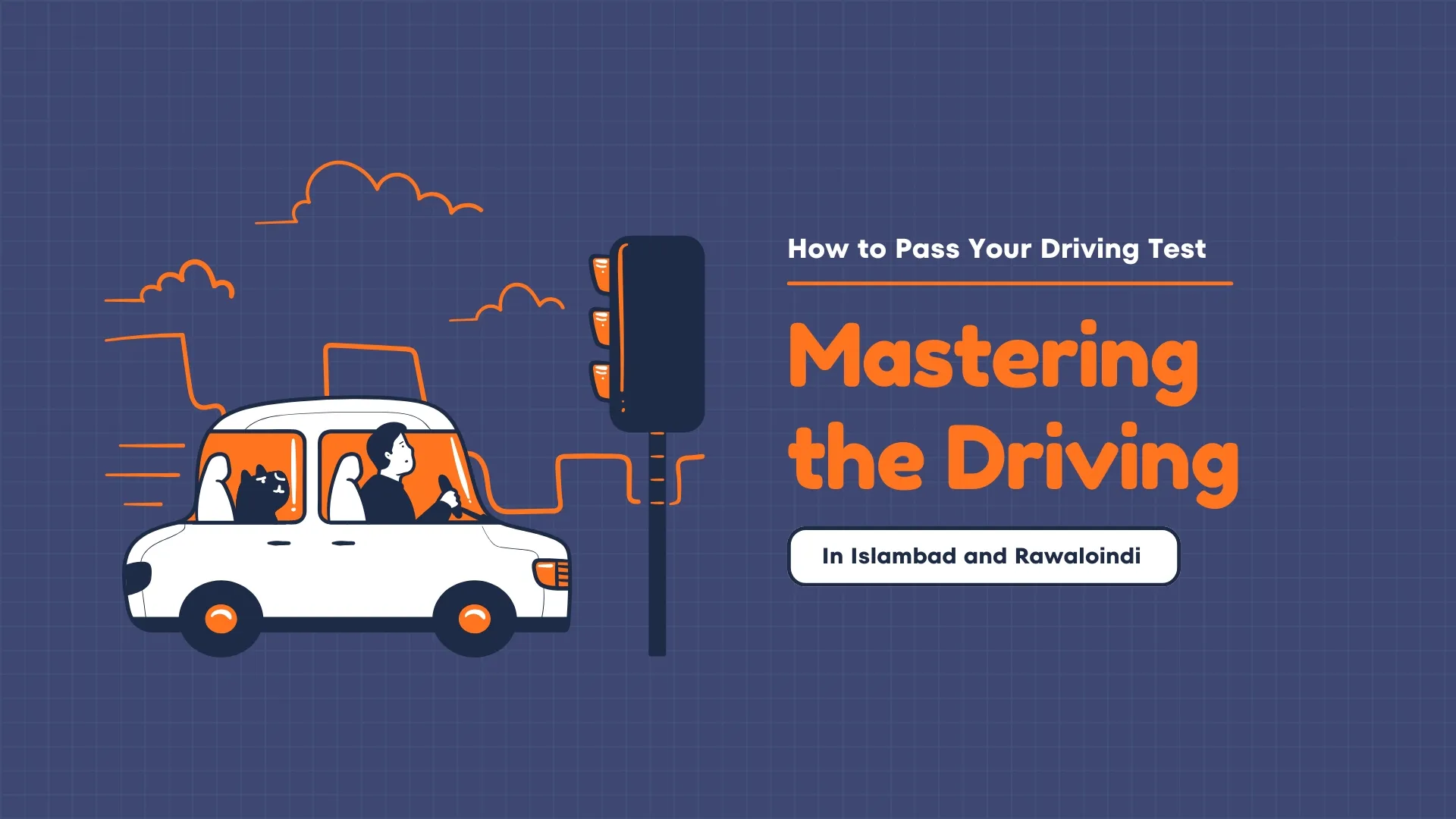
Passing your driving test and obtaining a permanent driving license in Twin Cities involves a rigorous two-part evaluation: a theoretical Sign Test and a practical Driving Test. To succeed, you must understand the technical requirements of the traffic police and the specific local regulations governing the process.
The difficulty of the test lies in its precision rather than the speed of driving. The passing rate is often low for first-time applicants due to the strict "zero-touch" policy on the practical track.
Before you touch a steering wheel, you must pass a digital theory test.
Format: 10 to 15 Multiple Choice Questions (MCQs) on a touchscreen.
Passing Score: Usually 80% to 90%.
Content: Mandatory signs (circles), Warning signs (triangles), and Information signs (rectangles).
Failure: If you fail the sign test, you cannot attempt the practical test and must return after a set period (usually 7 days).
The most common cause of failure is the "L-Shape" or "S-Shape" reverse track.
The Rule: You must drive forward into the track and then reverse out without touching any of the boundary cones or lines.
Automatic Failure: Any contact with a cone, stalling the engine more than once, or failing to use indicators results in immediate disqualification.
Passing on your first attempt requires mastering vehicle control at low speeds and memorizing traffic symbols.
Master the Half-Clutch: In manual cars, the entire test is won through "clutch control." You should be able to move the car at a "snail's pace" (walking speed) to give yourself time to adjust the steering.
Reference Points: When reversing on the L-track, learn to use your side mirrors as your primary guide. Align the rear wheel of the car with the "corner cone" before beginning your turn.
Mirror Calibration: As soon as you sit in the test car, adjust your mirrors. Many candidates fail because they try to drive with mirrors set for the previous candidate.
The Seatbelt Rule: Even if you are just moving the car 20 feet on a track, failing to wear your seatbelt is an automatic fail in both ITP and CTP.
There is no limit to the total number of attempts you can make, but each failure comes with a mandatory waiting period.
Retest Period (Rawalpindi/Punjab): If you fail the practical test, you can reapplying after 15 days.
Retest Period (Islamabad): The standard waiting period for a retest is 15 to 42 days, depending on current traffic office load and officer discretion.
Permit Expiry: You can keep attempting the test as long as your Learner's Permit is valid (6 months). If it expires, you must renew the learner permit and wait another 42 days before you can test for your license type again.
Schedules vary between the two cities and are subject to change during gazetted holidays.
Days: Monday through Friday.
Hours: Generally 08:30 AM to 01:00 PM for testing.
Appointment: You must book a slot online via the ITP website. Walk-ins are rarely accommodated for tests.
Days: Monday through Saturday.
Non-Commercial (Car/Bike): Often available 24/7 at specific "Khidmat Markaz" centers or during standard hours at the Race Course Headquarters.
Commercial (LTV/HTV): Usually restricted to specific days (often Tuesdays/Wednesdays) when the Motor Vehicle Examiner (MVE) is present.
Legally, you cannot take a permanent test until 42 days have passed from the date your Learner Permit was issued.
You must bring:
Original CNIC (not a copy).
Original Learner Permit.
Medical Fitness Certificate (Form B) (Mandatory if you are over 50 or applying for certain categories).
Islamabad: Visit islamabadpolice.gov.pk and use the "Online Appointment" system.
Rawalpindi: Download the Rasta App (Punjab Police) or visit the DLIMS Punjab portal to track your eligibility and locate the nearest testing center.
The main testing hub for Rawalpindi is located at Traffic Police Headquarters, Race Course Road, while Islamabad's primary center is at 9th Avenue, Shakarparian.
Reading is a start — here is how to actually get behind the wheel in Islamabad.