Rajia Saeed
I had a great experience learning with Ma'am Nayyar. I was very nervous when I started, but her patience and encouragement helped me build confidence and overcome my fear of driving.
Select your nearest office to chat on WhatsApp
Select your nearest office to call
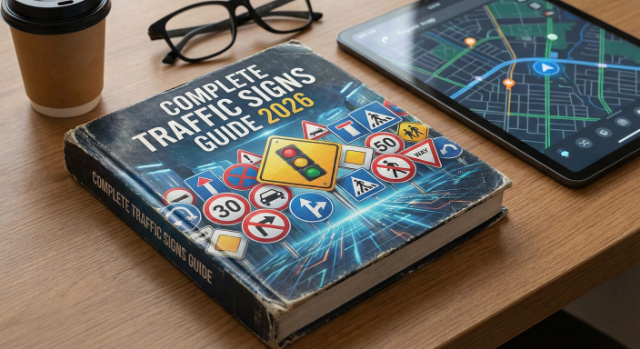
Traffic signs are divided into three main categories: regulatory signs (red/white) that tell you what you must or must not do, warning signs (yellow/diamond) that alert you to hazards ahead, and guide signs (green/blue) that provide direction and service information. Understanding these signs is crucial for safe driving and required for obtaining your driver's license.
Every day, millions of drivers rely on traffic signs to navigate safely. These visual cues communicate critical information in seconds, helping prevent accidents and keep traffic flowing smoothly. Whether you're a new driver preparing for your road test or an experienced driver brushing up on knowledge, understanding traffic signs is fundamental to road safety.
In this comprehensive guide, we'll break down every type of traffic sign you need to know, organized by category, with clear explanations of what each sign means and how to respond appropriately.
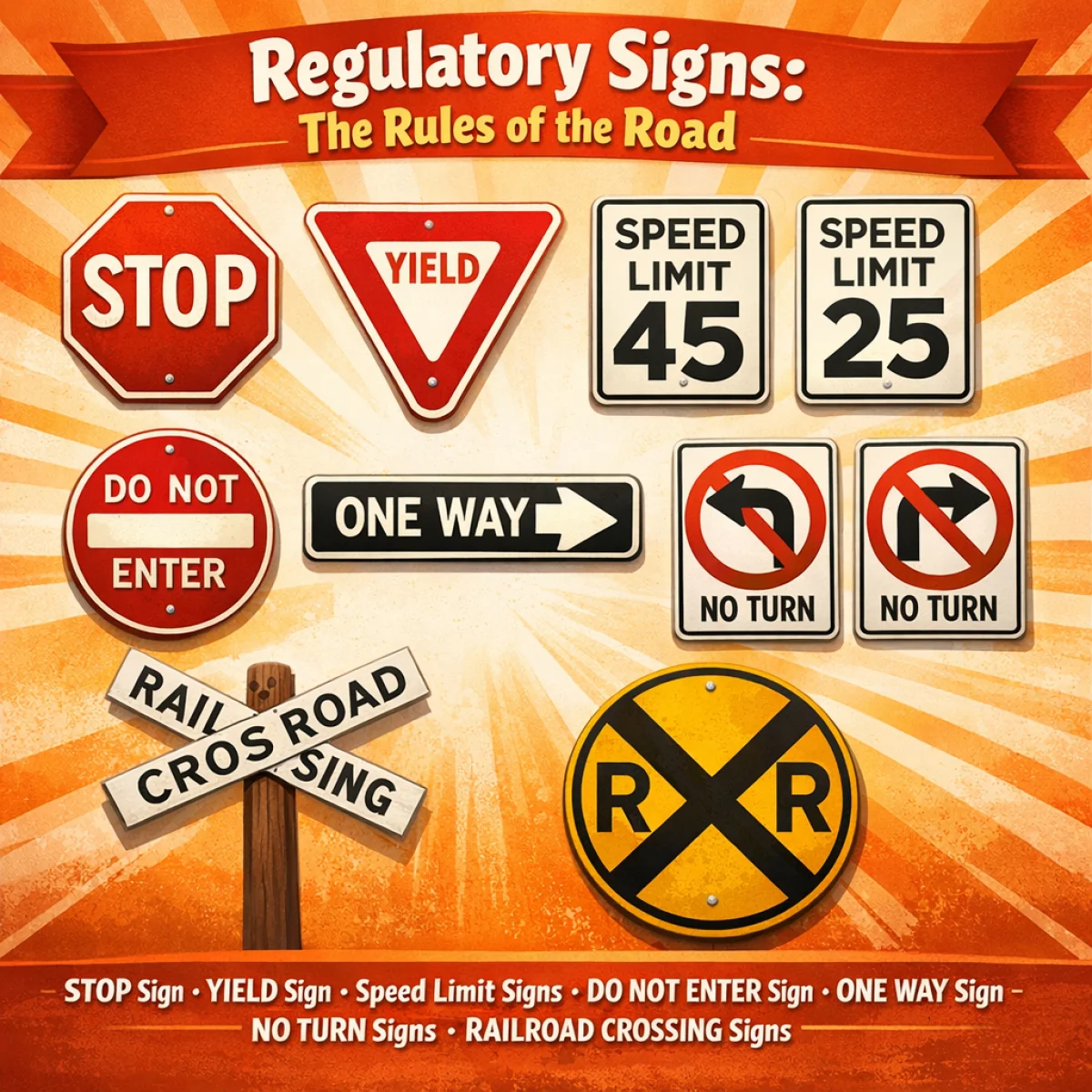
Regulatory signs tell you what you must or must not do. These signs have legal force, meaning violating them can result in tickets or penalties.
Common Characteristics:
Key Regulatory Signs:
STOP Sign
YIELD Sign
Speed Limit Signs
DO NOT ENTER Sign
ONE WAY Sign
NO TURN Signs
RAILROAD CROSSING Signs
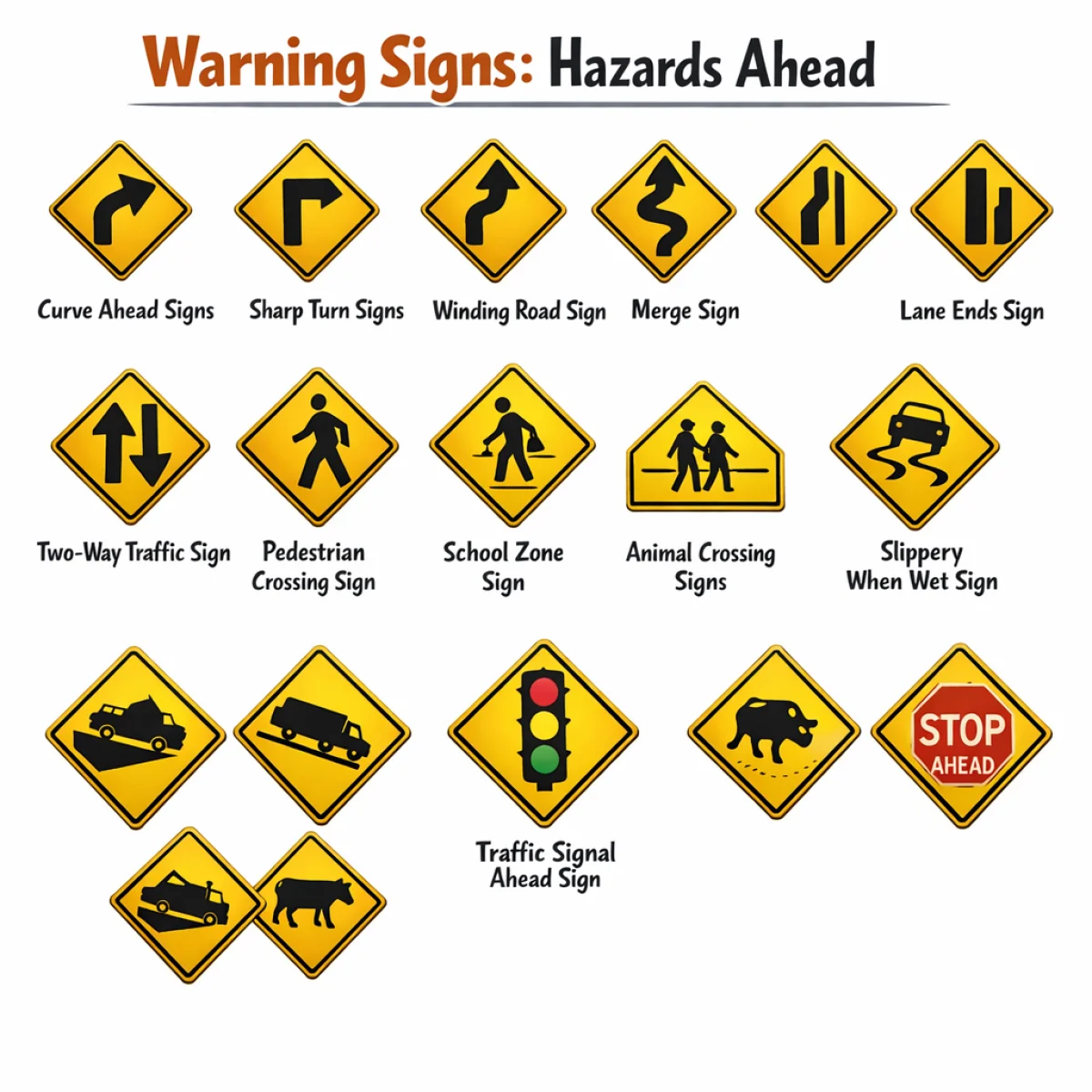
Warning signs alert you to potential hazards or changes in road conditions ahead. They give you time to slow down, adjust your driving, or prepare for unexpected situations.
Common Characteristics:
Key Warning Signs:
CURVE AHEAD Signs
SHARP TURN Signs
WINDING ROAD Sign
MERGE Sign
LANE ENDS Sign
TWO-WAY TRAFFIC Sign
PEDESTRIAN CROSSING Sign
SCHOOL ZONE Sign
ANIMAL CROSSING Signs
SLIPPERY WHEN WET Sign
HILL/GRADE Signs
TRAFFIC SIGNAL AHEAD Sign
STOP AHEAD Sign
Symbol: Red stop sign symbol
Meaning: Stop sign is ahead
Action Required: Begin slowing down
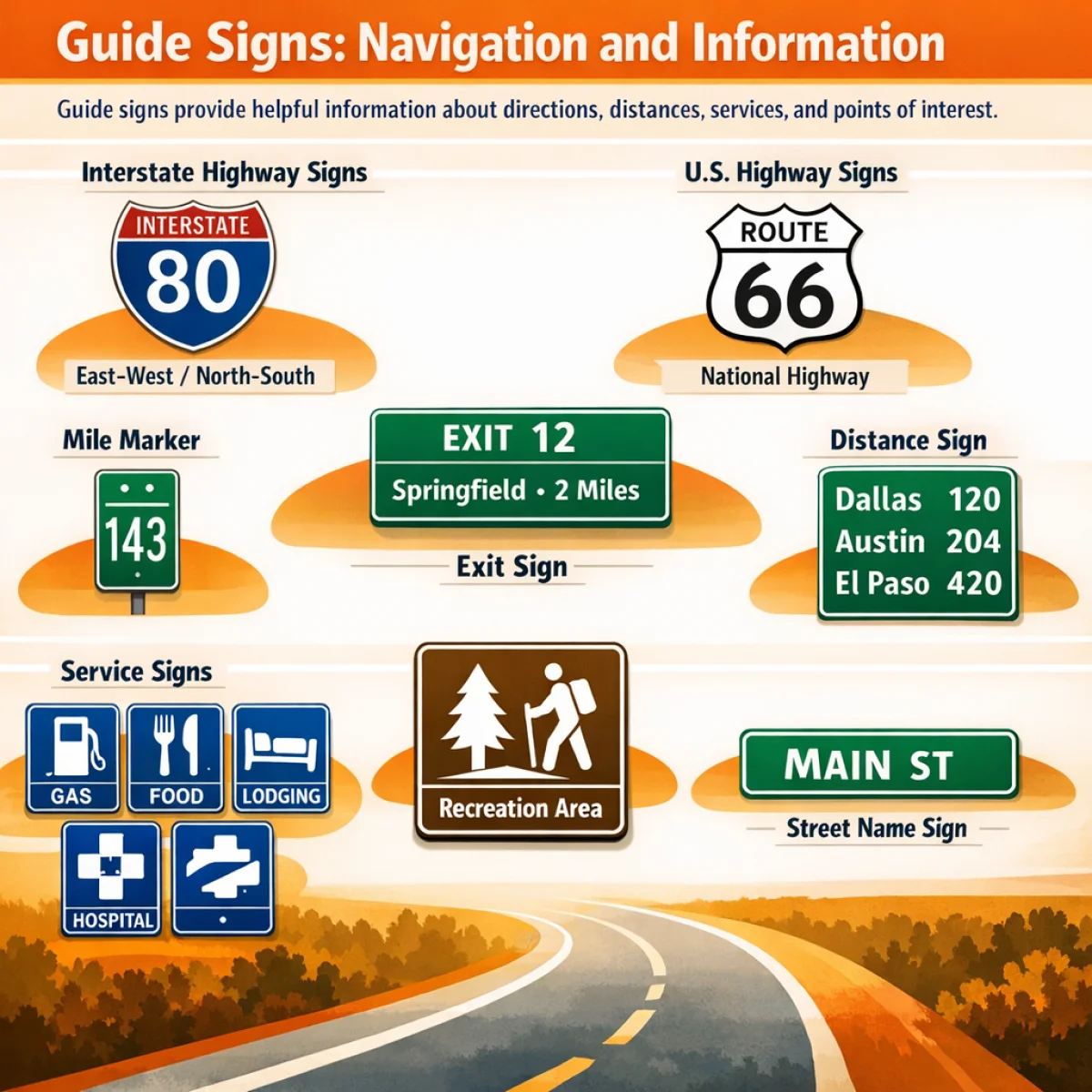
Guide signs provide helpful information about directions, distances, services, and points of interest. They don't have the legal force of regulatory signs but are essential for navigation.
Interstate Highway Signs
Shape: Shield
Color: Red, white, and blue
Meaning: Shows the interstate highway number
Information: Even numbers run east-west; odd numbers run north-south
International Highway Signs
Mile Marker Signs
EXIT Signs
DISTANCE Signs
SERVICE Signs
RECREATION Signs
STREET NAME Signs
Work zones use orange signs to alert drivers to construction and maintenance areas.
Common Work Zone Signs:
Work Zone Safety:
Reduce speed as posted
Stay alert for workers and equipment
Follow flagger's instructions immediately
Avoid distractions
Allow extra following distance
While not vertical signs, pavement markings are equally important traffic control devices.
Yellow Lines:
White Lines:
Special Markings:
Standard Traffic Light:
Red: Stop and remain stopped
Yellow: Caution, light is about to turn red; stop if safe to do so
Green: Proceed when safe
Arrows:
Flashing Lights:
The shape of a sign gives you information even before you can read it:
Understanding sign colors helps you categorize them instantly:
1. Study systematically: Learn one category at a time (regulatory, then warning, then guide signs)
2. Use flashcards: Create or download flashcard apps to quiz yourself
3. Practice recognition: When riding as a passenger, identify every sign you see
4. Take practice tests: Many DMV websites offer free practice tests
5. Understand the logic: Most signs use intuitive symbols and colors
6. Pay attention to shape: Shape recognition helps even when you can't read the sign yet
7. Know the hierarchy:
Regulatory signs = must obey
Warning signs = prepare and adjust
Guide signs = helpful information
Rolling stops: Always come to a complete stop at stop signs—your wheels must stop moving
Ignoring yellow lights: Yellow means stop if safe, not speed up
Misunderstanding yield signs: Yield means be prepared to stop and give right-of-way, not just slow down
Speed limit confusion: Speed limits apply to ideal conditions; adjust for weather and traffic
Missing work zone signs: Always reduce speed in work zones, even if workers aren't visible
Passing in no-passing zones: Double yellow lines and pennant signs prohibit passing
LANE USE CONTROL Signs
REST AREA Signs
SCENIC ROUTE Signs
BUS LANE Signs
BIKE LANE Signs
LOADING ZONE Signs
NO PARKING Signs
PARKING Signs
HANDICAPPED PARKING
TIME-LIMITED PARKING
While this guide focuses on U.S. traffic signs, it's worth noting that many countries use similar shapes and colors, thanks to international agreements. However:
Study your state's driver manual: Every state publishes an official manual with all traffic signs
Take online practice tests: Free resources available from most DMV websites
Quiz yourself regularly: Consistent review is more effective than cramming
Understand, don't just memorize: Know why signs look the way they do
Practice identifying signs while driving: With a licensed driver, call out signs as you see them
Focus on sign placement: Understanding where signs are typically placed helps you anticipate them
As you become more experienced, you'll learn to:
Scan ahead: Look beyond the immediate road to spot signs early
Anticipate sign sequences: Warning signs often precede regulatory signs
Read multiple signs together: Some situations require understanding several signs simultaneously
Understand implied meanings: Experience teaches you what to expect after certain signs
Modern developments:
LED signs: Display changing information (speed limits, lane closures)
Smart signs: Adjust based on traffic, weather, or time of day
Connected vehicle technology: Cars may receive sign information digitally in the future
Despite technology, traditional sign knowledge remains essential for all drivers.
Feeling anxious at a flashing red or malfunctioning traffic signal? Don't panic. Our trusted driving lesson service educates you on right-of-way protocols and how to treat it as a 4-way stop, ensuring you navigate unpredictable intersections with calm, legal precision.
If you miss a sign:
If a sign seems contradictory:
If signs are damaged or missing:
Mastering traffic signs is a fundamental skill that every driver must develop. These visual cues form a universal language of the road, keeping millions of drivers safe every day. While it may seem overwhelming at first, understanding traffic signs becomes second nature with study and practice.
Remember these key principles:
Whether you're studying for your permit test, preparing for your road test, or simply want to be a safer driver, knowing traffic signs inside and out is essential. Take the time to study thoroughly, practice regularly, and don't hesitate to ask questions when you're unsure.
Safe driving starts with understanding the signs!
You should know all regulatory and warning signs in your state's driver manual, typically 50-100 different signs. Focus on the most common ones first.
Violating regulatory signs can result in traffic tickets, fines, points on your license, and increased insurance rates. More importantly, it creates safety hazards.
Yes, the Manual on Uniform Traffic Control Devices (MUTCD) standardizes sign colors, shapes, and meanings across the United States.
Most warning signs are diamond-shaped, but special warnings, such as railroad crossings, use unique shapes (round) for instant recognition.
Yes, pavement markings are just as important as vertical signs. Focus on the yellow and white line meanings, arrows, and special markings.
Follow the most restrictive sign. If a speed limit sign says 45 mph but there's a school zone sign showing 25 mph during certain hours, follow the 25 mph limit during those hours.
Yes, electronic signs have the same legal authority as traditional signs. Always obey current displayed information.
Typically 500-700 feet before the hazard in urban areas, and further in rural/highway settings. This gives you time to react safely.
Reading is a start — here is how to actually get behind the wheel in Islamabad.