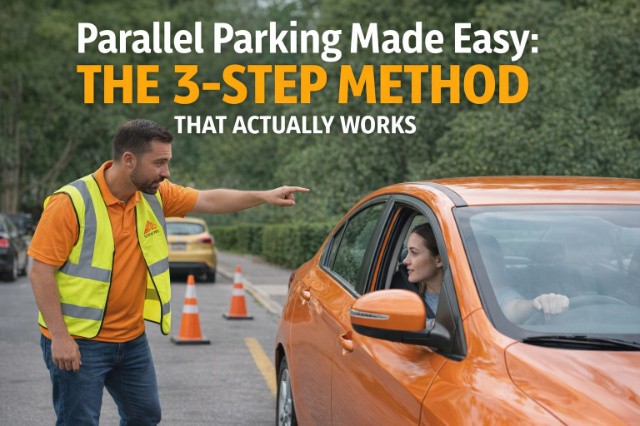
Parallel Parking Made Easy: The 3-Step Method That Actually Works
Parallel Parking Made Easy: The 3-Step Method That Actually Works
February 04, 2026
Parallel parking involves three main steps: signal and align your vehicle next to the car in front of the space, reverse at an angle while turning your steering wheel, then straighten your car within the parking spot. The key is finding a space 1.5 times your car's length, using your mirrors as reference points, and practicing in a safe area with cones before attempting street parking.
Parallel parking doesn't have to be the most stressful part of driving. Whether you're preparing for your road test or simply want to park confidently in tight city spaces, mastering this essential skill is easier than you think. With the right technique and practice, you'll be parking like a pro in no time.
💡
Expert Tip
Looking for the perfect spot but worried about hitting the curb? Don't panic. Our trusted driving lesson service will educate you on how to use your side mirror as a guide to judge distance, ensuring you park smoothly and curb-scrape-free every time.
Why Parallel Parking Feels Difficult
Many new drivers avoid parallel parking because it requires spatial awareness, precise vehicle control, and confidence under pressure. The good news? Parallel parking is a completely learnable skill that improves dramatically with practice. Once you understand the reference points and master the technique, it becomes second nature.
The Proven 3-Step Method
The most effective approach breaks parallel parking down into three simple, manageable steps.
Cone exercise: Set up cones or markers in an empty parking lot to simulate a parallel parking space. Start with a space that's much larger than needed, then gradually reduce the size as you improve.
Progression method:
1. Week 1: Practice with a space 2x your car's length
2. Week 2: Reduce to 1.75x your car's length
3. Week 3: Practice with 1.5x your car's length (standard size)
Daily practice: Even 10-15 minutes a day will dramatically improve your skills. Consistency matters more than marathon practice sessions.
Adjustments for Different Vehicle Sizes
Small cars: You'll have more room to maneuver, but be careful not to underestimate the turning radius.
SUVs and trucks: You'll need a larger space (closer to 2x your vehicle length). Take extra time to check blind spots due to the larger blind spots.
Sedans: These are ideal for learning as they offer good visibility and a moderate size.
💡
Expert Tip
Feeling confused about when to turn the wheel while reversing into the space? Don't panic. Our professional driving lesson service makes sure you master the timing with clear visual markers, turning a complex maneuver into a simple, repeatable skill.
Tips for Real-World Success
Scout the space first: Drive past the spot to assess its size before committing
Use your mirrors: They're your best tools. Adjust them properly before you start
Don't rush: Other drivers can wait; take your time to park correctly
Practice in low-traffic areas: Master the technique in quiet neighborhoods before attempting busy streets
Know your car's dimensions: Understanding your vehicle's size helps with spatial judgment
When to Keep Practicing
Remember, even experienced drivers need time to master parallel parking. If you're struggling, consider:
Booking a lesson with a professional instructor
Practicing with an experienced driver who can provide real-time feedback
Using a parking assist feature (if available) to see how the car naturally positions itself
Parallel parking is a skill that opens up countless parking opportunities and is essential for passing your driving test. With the 3-step method, Signal and Align, Reverse and Angle, Straighten and Park, you have a proven framework for success. Remember: practice makes perfect, and every expert driver started exactly where you are now.
At King Driving School, we're committed to helping you become a confident, capable driver. Whether you're preparing for your road test or simply want to improve your parking skills, our professional instructors are here to help.
Frequently Asked Questions
The parking space should be at least 1.5 times the length of your vehicle. For a standard sedan (about 15 feet), look for a space that's at least 22-24 feet long.
Your car should be 6-12 inches (about one hand's width) from the curb. Any farther and you're taking up too much of the traffic lane; any closer and you risk scraping your tires or wheels.
Don't panic! Simply put your car in drive, pull forward to reset your position, and try again. Even experienced drivers sometimes need a second attempt.
Most people can learn the basic technique in 2-3 practice sessions, but true confidence comes with regular practice over several weeks. Plan for at least 10-15 practice sessions to feel truly comfortable.
Your backup camera is helpful, but don't rely on it exclusively. Learn to use your mirrors primarily, as they give you a better view of the entire parking situation. Use the camera as a supplementary tool.
While most parallel parking is done on the right side, the same principles apply for left-side parking, just mirror the technique. However, left-side parking is generally only legal on one-way streets.
Take your time. Other drivers can wait, and rushing increases your chance of mistakes. If you feel too pressured, you can let them pass and try again when you feel more comfortable.
If the space looks tight, drive past it first to assess. As a rule of thumb, if you can't see at least 1-2 feet of space beyond the front and rear of where your car will be, the space is probably too small.
Our Reviews
30 reviews from our
students
RS
Rajia Saeed
“
I had a great experience learning with Ma'am Nayyar. I was very nervous when I started, but her patience and encouragement helped me build confidence and overcome my fear of driving.
AR
Abeeha Rehan
“
I had an excellent experience with King Driving School! As someone who had never driven before, it was exciting and really comfortable learning from Ma'am Laiba. She was friendly and helpful, and I a hundred percent recommend her to anyone who signs up for their driving lessons.
AM
Ayesha Malik
“
Ma'am Nusrat is an outstanding driving instructor who genuinely cares about her students' success. She creates a relaxed learning environment and gives practical tips that are easy to remember.
NQ
Naimah Qazi
“
I recently booked a 10-day driving package from King Driving School. My instructor Miss Tasneem did an incredible job. During these 10 days Miss Tasneem taught me really well with patience. I am very satisfied with King Driving School and especially my instructor.
KS
Kiran Salman
“
I had a great experience learning automatic driving at King Driving School. My instructor, Miss Sadaf, was patient, professional, and explained everything clearly, which made learning easy and helped me build confidence behind the wheel.
TJ
Tabinda Javed
“
Excellent driving instructor — Ma'am Sadaf. Very patient, professional, and friendly. She explains everything clearly and makes you feel confident behind the wheel. Her teaching style is easy to understand, and I learned a lot from every lesson. Highly recommended!
AM
Anmol Muskan
“
I'm 32 years old and I had never ridden a bike after marriage. I was very scared. I saw an ad for King Driving on Facebook and tried it. On the very first day, they took away 70% of my fear. They teach me very patiently.
HK
Haleema Khan
“
My daughter learnt bike from Anila ma'am and honestly it was the best decision. She was absolutely zero and was very scared too. But Anila ma'am explained every step with love and never got angry.
AR
Aliza Raj
“
I am truly grateful to Teacher Anila from King Driving School. She taught me scooty from the very basics with so much patience and clarity. Every step was explained in detail and all my confusions were cleared in a very calm way.
HA
Hussain Ahmad
“
I had an excellent experience with Ma'am Hania (PWD Branch). She is an outstanding instructor who is professional, calm and highly supportive. She explained everything clearly and helped me feel confident and comfortable while driving.
GN
Ghazia Naeem
“
I have a great experience with Ma'am Sajida (I-10 branch). She is so sweet and humble. I learned a lot from her — she guided me through everything. Now I feel I chose the right instructor for my driving.
HW
Hafsa Waqar
“
I had the pleasure of learning to drive with Miss Sajida and I couldn't have asked for a better teacher. She is very nice, calm, and encouraging. Even when I made mistakes she explained things with so much patience and made me feel comfortable. Thanks to her guidance, I passed my test with confidence. Highly recommend her!
SR
Samia Rashid
“
I completed 20 days of driving lessons at King Driving School. The instructor Ma'am Sonia was highly professional, patient, and provided clear guidance throughout. My confidence and driving skills improved significantly. I would definitely recommend this school.
AA
Ayesha Ali
“
I took manual car classes with Ms Fatimah at King Driving School. She is very polite, patient, and explains everything clearly. She helped me overcome my fear of driving manual. 5 stars!
SB
Samina Bukhari
“
I did a 10-day crash course with King Driving School and my instructor was Ms. Zara. Over our 10 days together, her exceptional technical knowledge and structured approach completely transformed my driving.
ZA
Zahra Ali
“
I had an extremely good learning experience with Ma'am Ghazala at King Driving School. She taught me how to drive manual properly in just three days with extensive practice. She is a great instructor who reinforces mistakes and is very patient and professional.
MW
Maria Wassan
“
I had a wonderful experience learning driving from Ma'am Kaneez at King Driving School. She is extremely kind, patient, and professional. She guided me with great care and explained everything clearly and step by step.
TZ
Tooba Zahoor
“
I loved my experience with King Driving School. They took criticism well and responded to every problem encountered. My driving instructor Ma'am Kaneez was extremely polite and respectful.
F
Faiza
“
I'm from the UK. Fantastic experience learning to drive with Ma'am Bushra. She creates a highly comfortable, relaxed, and judgment-free learning environment, which made a huge difference for me. I highly recommend my instructor!
HS
Harmann Shahid
“
Best driving school in Islamabad! I learned with Instructor Munawer Abbas and he is amazing.
IP
Ijaz Prince
“
I had a great experience with King Driving School. At first, I wasn't comfortable with my instructor, but Wahab Sir discussed it with his boss and quickly arranged Sir Asif for me.
AT
Ayesha Tahir
“
I had a great experience learning to drive from Sir Asif at King Driving School. I completed a 15-day driving course, and throughout the course, Sir Asif was extremely professional, patient, supportive, and knowledgeable.
MH
Moizz ul Haque
“
Sir Asif really helped me. By the 10th day in our 15-day course I was doing everything from driving on a straight road to parallel parking, and I feel really confident when driving. Would recommend 100%.
MS
Muhammad Shaiel
“
I had the pleasure of having Sir Naveed as my instructor for an hour session on the L-shape test. He stayed patient with me as I practiced, correcting my mistakes and guiding me through the turn. Thanks to his guidance, I have passed my license test Alhamdulillah.
UT
Usama Tariq
“
Very professional team, especially Mr. Naveed from whom I took classes and Alhamdulillah got my licence on first attempt.
AV
A.Ayesha Vlogs
“
I have taken admission in King Driving School and had a very great experience! My instructor, Mam Sadaf, guided me very well and helped build my confidence. She made me feel comfortable, and her friendly nature made the learning process enjoyable. I highly recommend her!
NS
Nida Sadiq
“
I had a great experience learning to drive with Mam Seema. She is very nice, humble, and professional. Her teaching style is encouraging and clear, making me a more confident driver. I highly recommend her as an instructor.
HL
Hana Lee
“
I took a five-day driving lesson course with Ma’am Sadaf. I had never driven before, but thanks to her, I gained a lot of confidence in my driving. She made sure I was calm throughout my lessons and consistently checked up on me. I am very grateful for this opportunity.
SJ
Soha Jehangir
“
I had the pleasure of learning driving from Miss Seema. She is incredibly patient and professional. Her dedication is extremely appreciable, and I can safely say she has instilled confidence in me to become a great driver. I highly recommend her for a calm and smooth learning experience.
AA
Anooshay Abbasi
“
I have had a great experience at King Driving School. My instructor, Mrs. Sajida, is honestly a very good teacher with a lot of patience. She has never shouted or shown any attitude. Thanks to her, I passed my exam on the first attempt and truly enjoyed the entire learning experience.